
Deep-Earth Currents May Explain the Planet’s Missing Billion Years
Scientists may have identified the process behind the Great Unconformity, one of geology’s largest gaps in the record of Earth’s past. In many parts of the world, sedimentary rocks formed during the Cambrian period, about 540 million years ago, lie directly on much older crystalline rocks such as granite. The layers that should record the intervening history are missing: some gaps represent roughly 200 million years, while others exceed a billion.
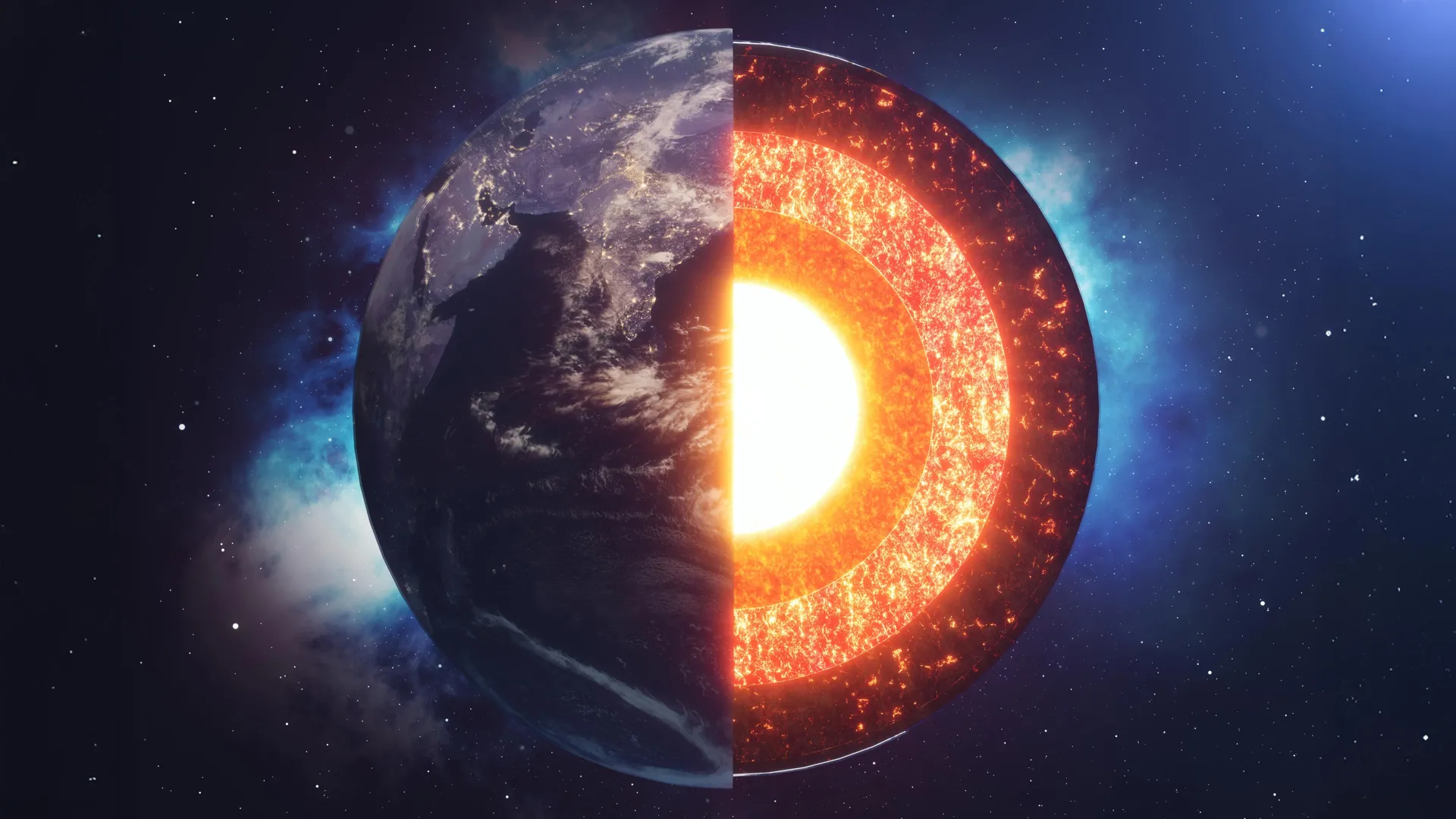
Research led by Santosh Dhungana, a PhD candidate at the University of Wollongong, and Associate Professor Nicolas Flament used computer simulations to model the movement of Earth’s mantle over hundreds of millions of years. The mantle is hot, mostly solid rock that flows extremely slowly, and its heat-driven circulation can gradually lift or lower enormous areas of the surface.
The models suggest that mantle convection raised the ancient continental cores of Laurentia, Baltica and North China during the Neoproterozoic Era, between roughly one billion and 540 million years ago. As these regions remained elevated, wind, water and other forces could erode vast quantities of rock, removing layers that represented hundreds of millions of years of geological history. Later subsidence allowed oceans to cover the worn-down surfaces and new sediment to accumulate, preserving the sharp boundary now visible in places including the Grand Canyon. The same process could explain why the missing interval varies so widely from one location to another.
Continue in the app — vote & join in ➔