
NASA Tests Mars Helicopter Blades at Supersonic Speeds
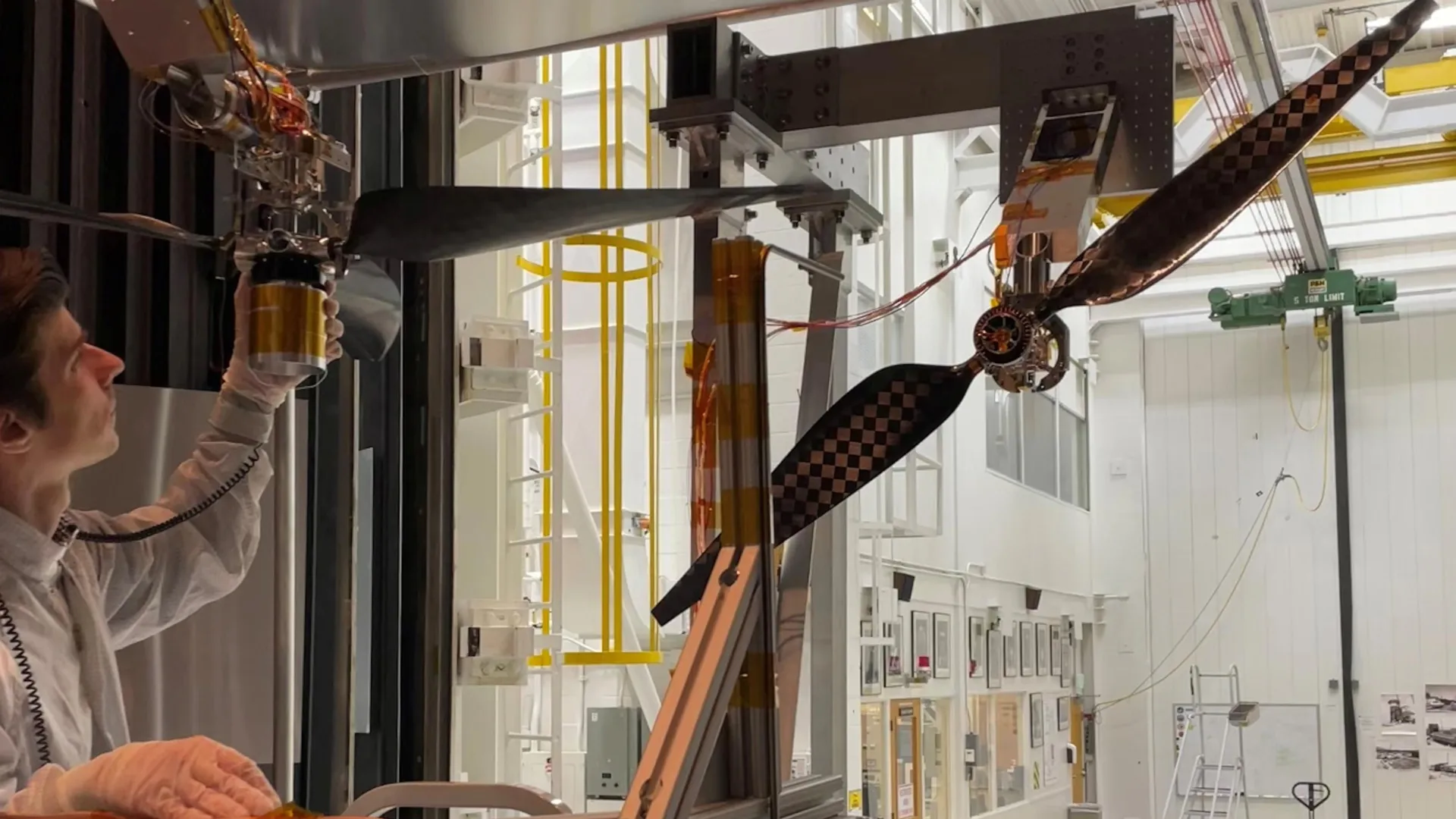
NASA has tested experimental rotor blades for future Mars helicopters at speeds beyond the sound barrier, addressing one of the central difficulties of powered flight on the Red Planet. During 137 tests in March at the Jet Propulsion Laboratory in Southern California, engineers spun a three-bladed rotor in a chamber that reproduced Mars’ thin, carbon-dioxide-rich atmosphere and exposed it to simulated winds. The blade tips exceeded Mach 1 without breaking apart, while the design offered the potential for 30% more lift.
Mars’ atmosphere is only about 1% as dense as Earth’s, so helicopter rotors must spin exceptionally fast to push enough air downward. The speed of sound is also lower on Mars—about 540 mph (869 kph), compared with approximately 760 mph (1,223 kph) at sea level on Earth—because the planet is colder and its atmosphere is largely carbon dioxide. NASA kept Ingenuity’s rotors at 2,700 revolutions per minute and planned its 72 flights around a tip speed of Mach 0.7 in still air, leaving a margin for winds that could increase the relative speed.
Ingenuity, which made the first powered, controlled flight on another world on April 19, 2021, was primarily a technology demonstrator and was not designed to carry scientific instruments. The new rotor work could support more capable aircraft, including NASA’s proposed SkyFall project, able to transport heavier sensors, fly farther, and investigate terrain beyond the practical reach of rovers. Aerodynamic systems for the tests were developed and manufactured by AeroVironment.
Continue in the app — vote & join in ➔