
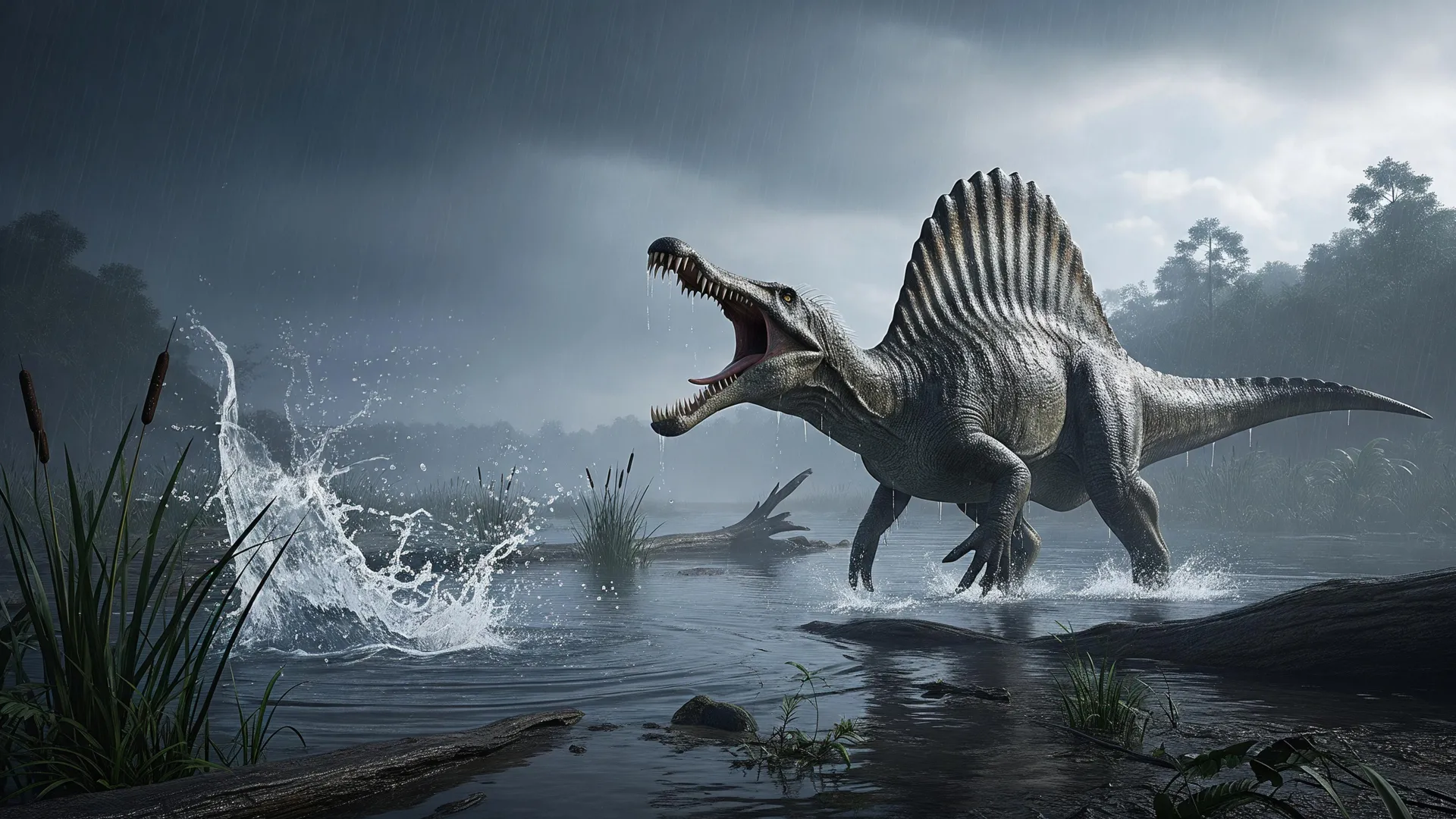
Evidence suggests Spinosaurus spent most of its life underwater
A Yale University study published in Current Biology offers new evidence about how vertebrates returned to the water after their ancestors had adapted to land. Researchers examined hundreds of fossil and modern specimens from institutions worldwide, compiling more than 11,000 measurements alongside photographs and CT scans. Machine-learning models trained on living animals linked skeletal proportions to known lifestyles while accounting for evolutionary relationships, allowing the team to infer aquatic habits and soft-tissue features that fossils rarely preserve.
The analysis supports a predominantly aquatic lifestyle for Spinosaurus, the giant predator that lived in northern Africa roughly 113 million to 94 million years ago. Its anatomy indicates that it spent the vast majority of its time submerged, strengthening the case for underwater hunting rather than a heron-like existence confined mainly to shorelines and shallow water.
By contrast, mesosaurs, which lived about 290 million to 274 million years ago in areas now belonging to South Africa and eastern South America, appear to have remained amphibious despite giving birth to live young. Their limbs suggest regular movement onto land, comparable to an alligator or platypus. More broadly, the study concludes that no known Paleozoic marine reptile became completely aquatic. Forelimb proportions proved especially informative: the models predicted flippers and highly or fully aquatic lifestyles with more than 90% accuracy, aided by a statistical technique originally developed during World War II to assess whether radar signals represented enemy aircraft.
Continue in the app — vote & join in ➔