
A decades-old mystery about light could hold the key to faster internet
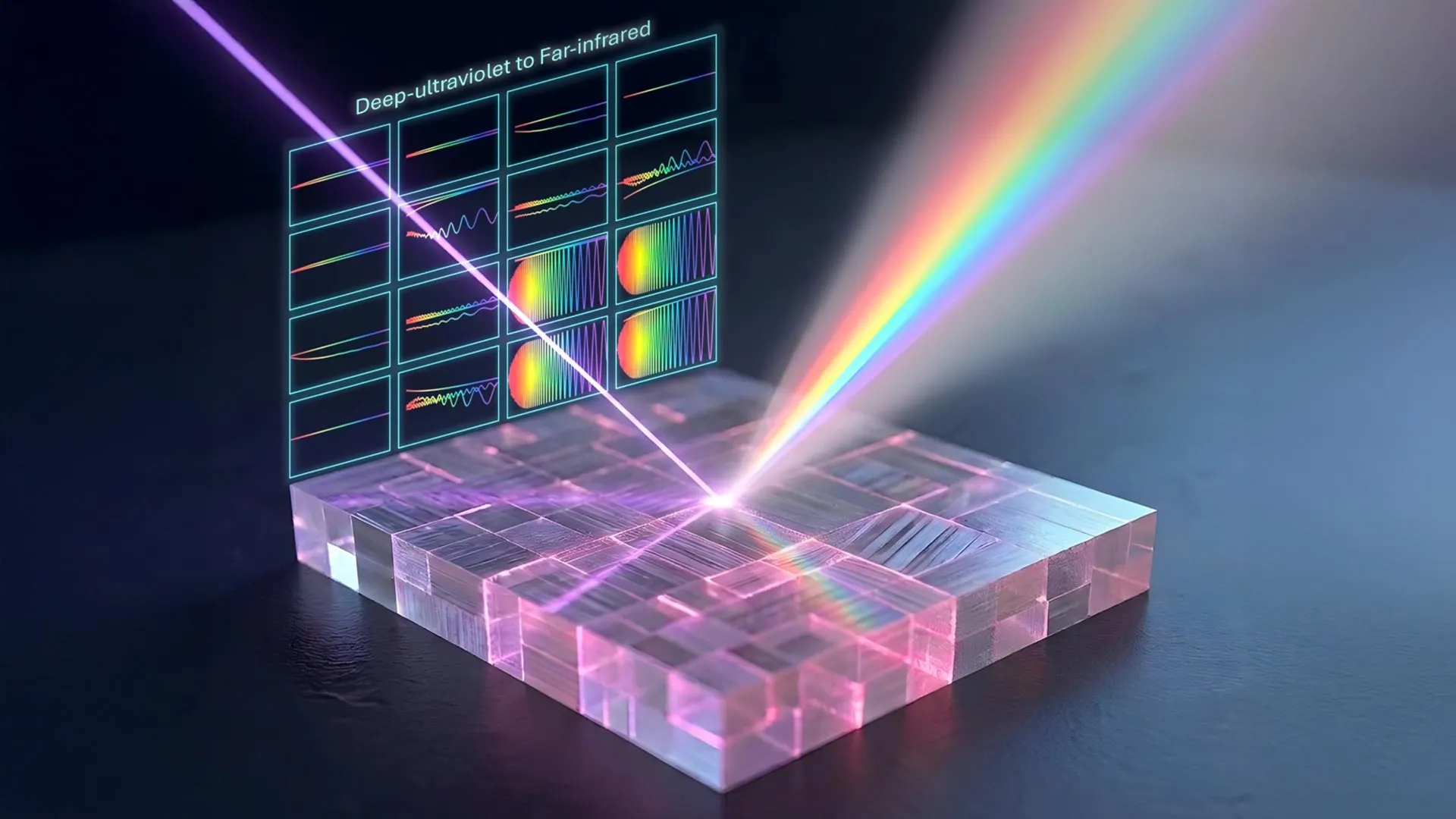
A KAIST-led team with Caltech, the Korea Research Institute of Standards and Science (KRISS) and U.S. firm J.A. Woollam Co. has measured how barium titanate (BTO) steers and absorbs light from the ultraviolet into the far infrared, closing decades of conflicting reports that had made the crystal hard to engineer. KAIST (President Choongsik Bae) announced the work on November 8. It was led by Professor Min Seok Jang of KAIST’s School of Electrical Engineering with Professor Harry A. Atwater’s group at Caltech.
BTO is valued for a strong Pockels effect: an applied voltage changes how it treats light, which is useful in optical modulators that turn electrical data into optical signals. Designers still need two numbers—the refractive index, which governs how light travels, and the extinction coefficient, which measures absorption—to predict loss inside a waveguide. Those figures have been unreliable because BTO can contain microscopic domains whose crystal axes point in different directions and mix distinct optical responses in a single sample.
Instead of mixed-domain crystals, the researchers studied two types of single-crystal specimens with relatively uniform domain orientation and used Mueller matrix spectroscopic ellipsometry, which tracks how polarization changes when light reflects from or passes through the material. They covered 190 nanometers to 40 micrometers, split that range into three spectral regions, and analyzed each separately, mapping how index and absorption depend on wavelength and crystal orientation. Combining ellipsometry with transmission measurements, they found extremely low absorption, with extinction coefficients of about 10⁻⁵ between 2 and 10 micrometers. They also developed a method that uses domain orientations to predict the overall optical behavior of multi-domain crystals, giving engineers a firmer basis for lower-loss, faster optical links.
Continue in the app — vote & join in ➔