
Ice at Mars’ north pole is far cleaner than scientists thought
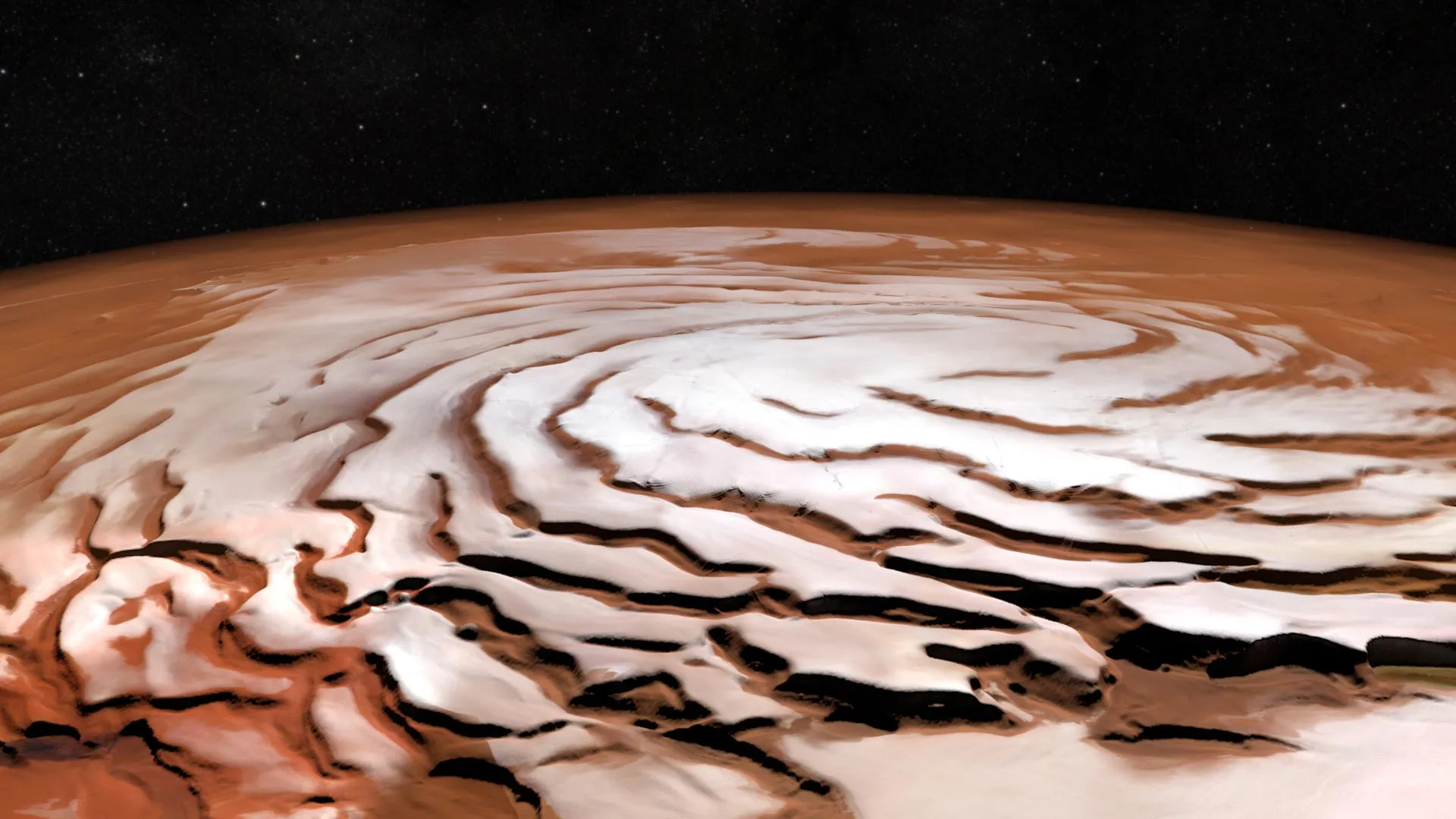
Ice at Mars’ north pole holds far less dust than scientists long assumed, according to a University of Washington study in npj Space Exploration. Most Martian water ice sits under surface dust, but some is exposed at the poles. Dust darkens ice, cuts the sunlight it reflects, and can warm it so it vaporizes faster. Earlier work put dust as high as about 25% by mass in the uppermost polar ice; the new analysis finds exposed older ice closer to 3%.
Aditya Khuller of UW’s Applied Physics Laboratory and geoscience graduate Pari Mohan recalculated ice properties with methods adapted from snow-and-ice research by professor emeritus Steve Warren, after Khuller found that a common technique designed for lunar soil did not match Earth observations. They combined 2008 NASA Phoenix samples from near the north pole with orbiter data. NASA’s first successful Mars landing was 50 years ago; Phoenix followed the 1999 Polar Lander loss near the south pole.
The ice is layered “like an ice-cream sandwich”: relatively dusty frost that forms each Martian winter sits between thicker, cleaner ice. In summer the frost vanishes and older, cleaner ice is exposed. Those deposits likely began as snowfall thousands of years ago. Mars’ two small moons do not stabilize its tilt the way Earth’s moon does, so the planet’s axis “oscillates wildly,” driving ice ages and leaving ice near the surface over about one-third of the planet. In earlier Communications Earth work, Khuller’s team argued that ice–dust layering might even create niches suitable for life.
Continue in the app — vote & join in ➔