
Black hole merger outcomes may follow a simple entropy-maximization rule
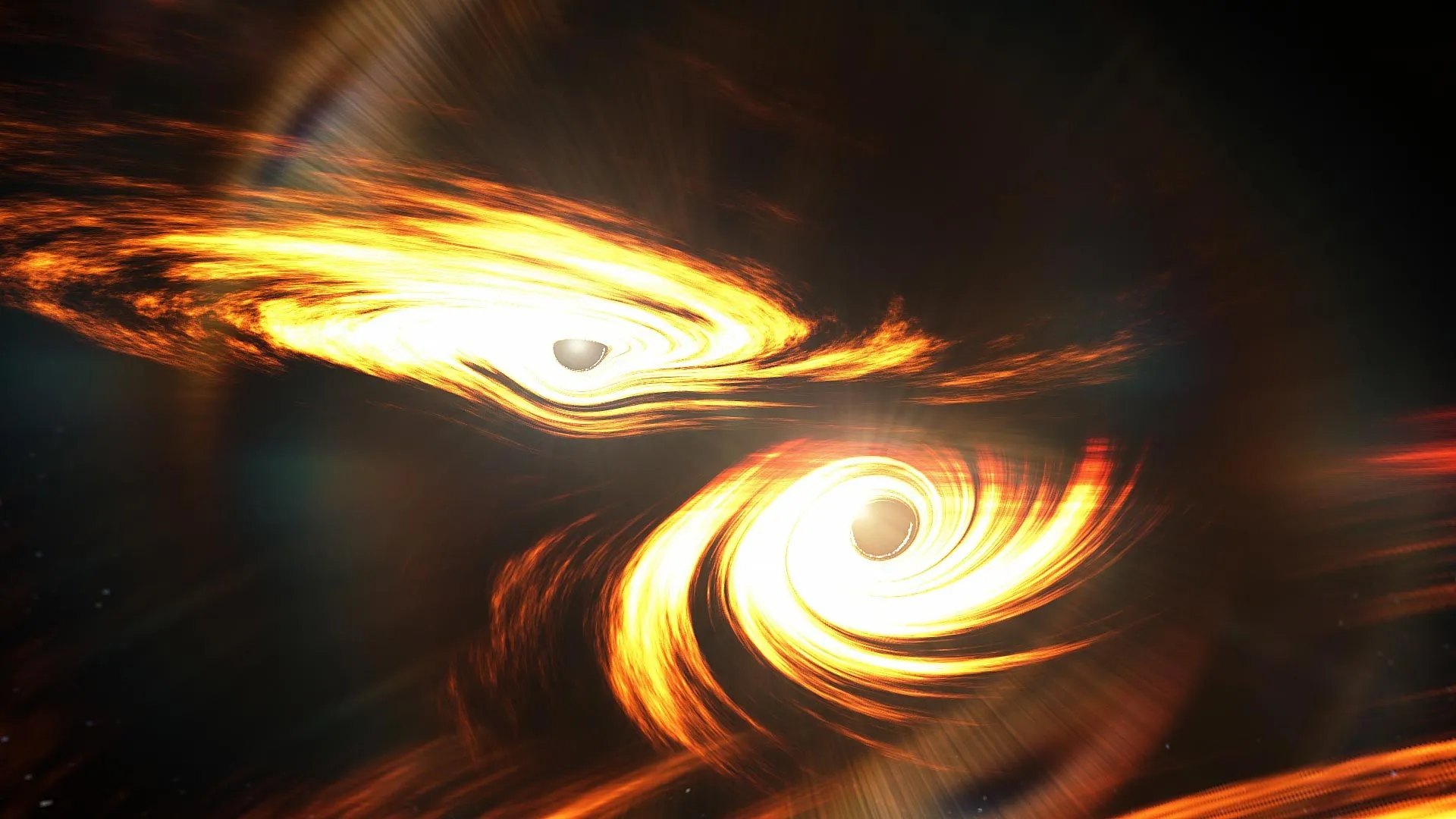
A Penn State–led team of physicists reports that the mass and spin of the black hole left after two collide may follow a simple thermodynamic rule: after energy and angular momentum carried away by gravitational waves are accounted for, the remnant appears to settle into the state that maximizes entropy. That shortcut closely matches remnant properties that are usually obtained only by running Einstein’s general relativity on supercomputers. The work appears in Physical Review Letters, where it was chosen as an editor’s suggestion, and it may point to deeper links between thermodynamics and gravity.
Mergers begin as two orbiting black holes spiral together, then combine into one larger hole. The energy released warps spacetime and produces gravitational waves that detectors on Earth can record even from collisions billions of light-years away. First author Monica Rincon-Ramirez, a postdoctoral scholar in physics in Penn State’s Eberly College of Science, describes the newborn remnant as ringing like a struck bell until it radiates further waves and calms into a stable state set by only those two numbers—final mass and spin. Co-authors include Nathan K. Johnson-McDaniel of the University of Mississippi (a 2011 Penn State physics doctorate) and Vaishak Prasad, a Penn State postdoctoral researcher in astronomy and astrophysics. They extend a 1970s parallel between black-hole properties and those of gases, after Stephen Hawking showed black holes can radiate and lose energy. A separate recent Penn State study had already broadened Hawking’s formulation to dynamic holes that form, merge, and evaporate. Entropy here is treated as the number of microscopic arrangements consistent with a given overall state, so systems tend toward higher-entropy configurations—now apparently including binary black-hole remnants.
Continue in the app — vote & join in ➔