
Atom-Scale Primordial Black Holes Could Destroy Stars from the Inside
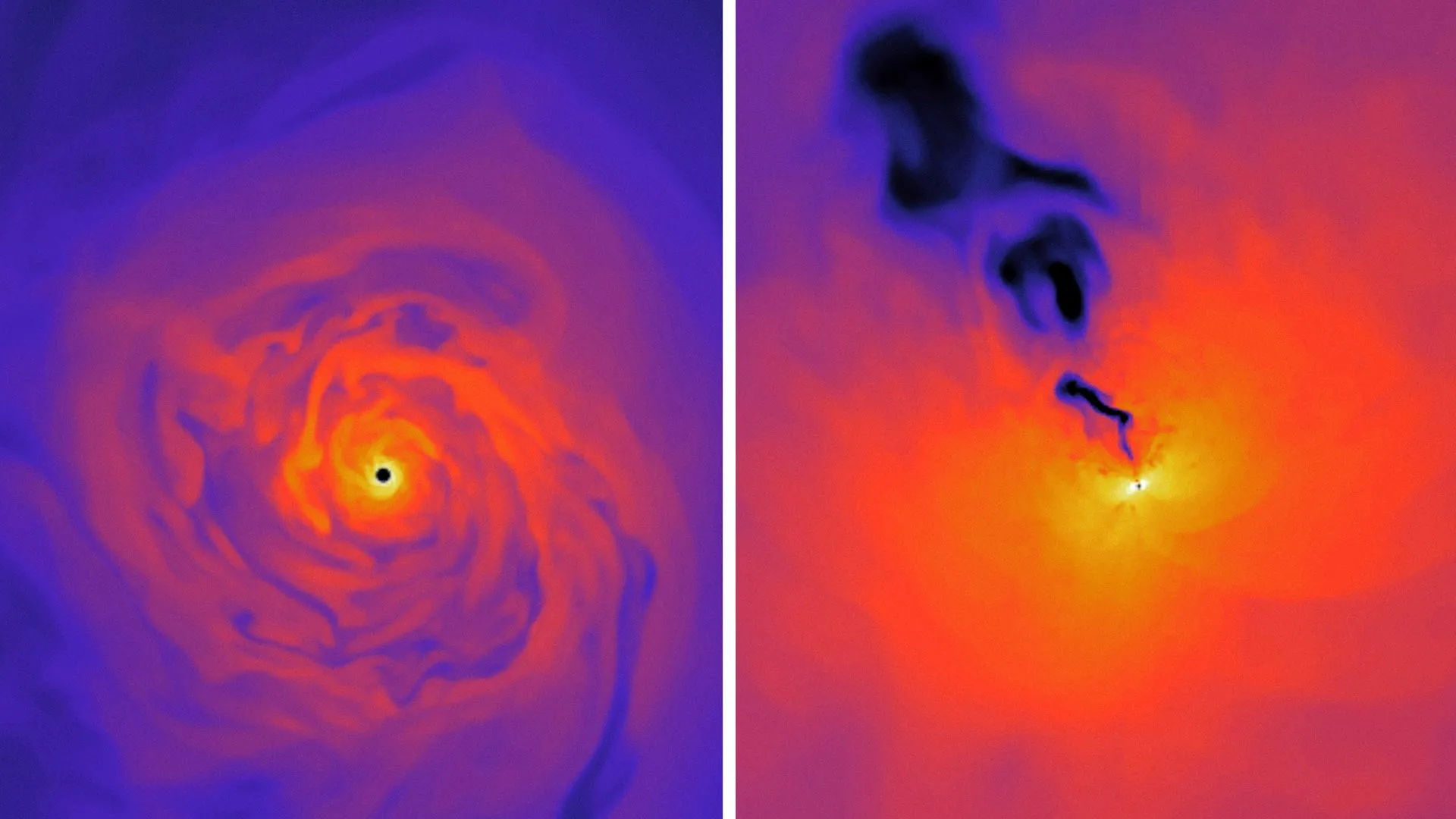
MIT researchers and collaborators report in The Astrophysical Journal that primordial black holes—objects that could have formed in the first fraction of a second after the Big Bang when dense matter collapsed under its own gravity—might still lurk in the cosmos and destroy Sun-like stars from the inside. If they exist, they could also make up a substantial share of dark matter. Lead author Ore Gottlieb, an assistant professor of physics at MIT, and colleagues including Matteo Cantiello of the Flatiron Institute, Cameron Norton and Matthew Kleban of New York University, and Ken Van Tilburg of Stanford University combined theory with three-dimensional simulations that mix general relativity, fluid dynamics, stellar evolution, and particle physics.
Stephen Hawking’s idea of Hawking radiation implies the tiniest primordial black holes would already have evaporated; survivors could be about the size of an atom yet as massive as an asteroid, or about a millionth of Earth’s mass. A lone star’s gravity is generally too weak to capture one. A companion star or planet can change the three-body dynamics so the hole repeatedly plows through the star, losing orbital energy to friction over thousands or millions of years until it settles in the core and begins to feed. If the star spins fast enough, infalling gas forms an accretion disk. Gottlieb calls that a death sentence: jets can punch through the star and explode it within seconds, producing intense blue and ultraviolet light plus X-rays and gamma rays that existing telescopes might already see—offering a way to test whether primordial black holes exist.
Continue in the app — vote & join in ➔