
Scientists discover oldest quasar formed 630 million years after the Big Bang
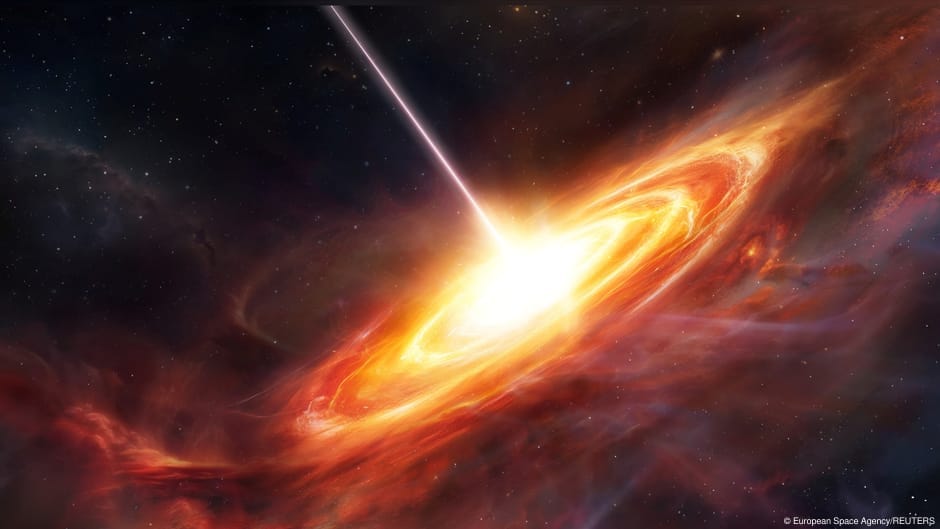
Researchers at the European Space Agency announced Tuesday the most distant — and therefore oldest — quasar yet observed: J1504+6252, nicknamed Dún Aonghas. Astronomers are seeing it as it was 13.1 billion years ago, when the universe was less than 5 percent of its present age, only about 630 million years after the Big Bang. The find, led by a German astronomer and his team, was published in Astronomy and Astrophysics.
A quasar is the extremely bright core of an active galaxy, powered by gas falling into a supermassive black hole. That phase is brief: the nucleus can outshine the rest of the galaxy. Co-author Silvia Belladitta of the Max Planck Institute for Astronomy in Germany and the INAF Bologna Observatory of Astrophysics and Space Science in Italy said that as gas, dust and other matter fall toward the black hole, they form a swirling accretion disk that heats to extreme temperatures and radiates so much energy that it can outshine the rest of the galaxy by hundreds or even thousands of times. That brightness makes quasars visible across billions of light-years and lets astronomers study how the first galaxies formed and how the supermassive black holes at their centers grew so large.
Lead author Julien Wolf of the European Southern Observatory in Germany said the object adds evidence that some early-universe systems developed remarkably quickly: by 630 million years after the Big Bang, this black hole had already grown to about 360 million times the mass of the Sun and was shining as a quasar. The discovery supports a picture in which supermassive black holes form through the direct collapse of large gas clouds and then accumulate more matter. Dún Aonghas was first detected by ESA’s Euclid telescope and then characterized with a combination of ground- and space-based telescopes. Euclid is designed to probe dark matter, the unseen mass that helps bind galaxies, and dark energy, the force that drives them apart.
Continue in the app — vote & join in ➔